Artificial intelligence and RPA are helping businesses work smarter and faster than ever. With AI-powered cloud solutions, companies can automate tasks easily, gain real-time insights, and improve processes without heavy infrastructure costs. Modern smart computing tools make it simpler to solve problems quickly and make better decisions.
Marketing teams are using AI-assisted marketing approaches to deliver personalized experiences, optimize campaigns, and anticipate customer needs. In finance, AI-based financial solutions support risk analysis, detect fraud, and guide smarter investments while minimizing errors.
Bringing these technologies together allows organizations to streamline operations, provide better customer service, and achieve stronger results. From AI in IT service management – IA en la gestión de servicios de TI to transforming customer support with AI, combining intelligent automation, cloud tools, smart computing, and AI insights is reshaping how modern businesses succeed.
What Are AI and RPA?
What is Robotic Process Automation (RPA)?
RPAuses software “robots” (bots) to mimic human actions in digital systems. These bots follow rules to perform repetitive, predictable tasks such as:
- Copying data from one application to another
- Filling in forms and submitting them
- Moving files and folders
- Triggering simple workflows based on defined conditions
- Generating routine reports from structured data
Think of RPA as adigital workforcedesigned to handle repetitive, high-volume work with speed, accuracy, and consistency.
What is Artificial Intelligence (AI)?
AIrefers to systems that can perform tasks typically requiring human intelligence. Modern AI often uses machine learning and other techniques to:
- Recognize patterns in data
- Understand text, speech, or images
- Make predictions or recommendations
- Continuously improve through experience
Where RPA excels at following explicit rules, AI shines injudgment, interpretation, and learning.
Top 10 Robotic Process Automation and Artificial Intelligence Platforms Transforming Customer Support and IT Services
- Bright Pattern
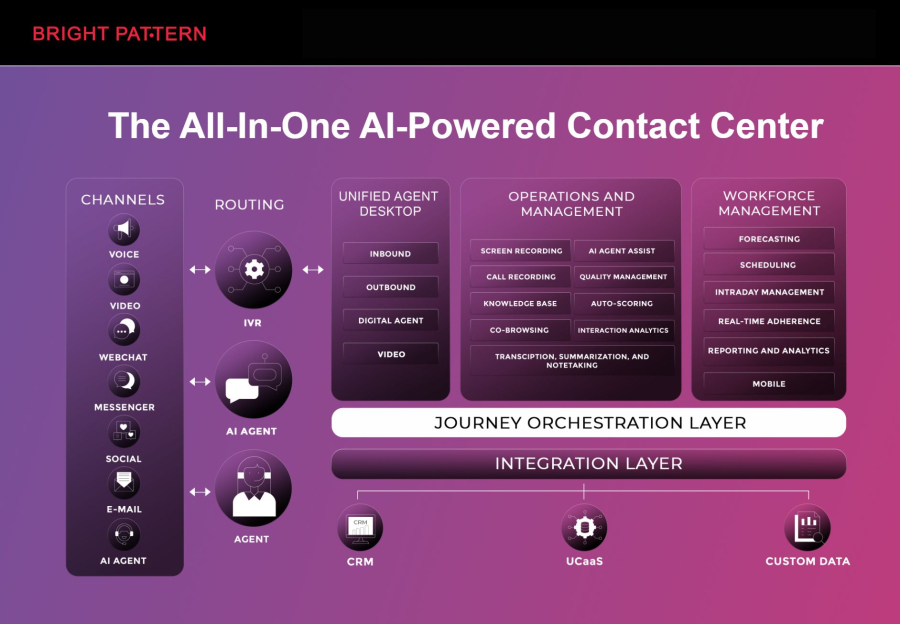
Bright Pattern is a leading platform in the artificial intelligence and RPA space, offering advanced solutions for customer service, IT service management, and intelligent automation. Its cloud-based design allows organizations to scale quickly while delivering a seamless experience for both agents and customers. Bright Pattern combines AI-driven insights with easy-to-use automation tools to streamline operations and improve response times.
Key Features:
- Omnichannel contact center automation
- AI-powered chatbots and virtual assistants
- Real-time analytics and reporting dashboards
- Easy integration with CRM and ITSM systems
- Automated workflows for repetitive tasks
- Bright Pattern is ideal for businesses looking to enhance customer support while reducing operational costs and increasing efficiency. Its platform is built for flexibility, allowing organizations to adapt AI and RPA tools to their unique processes.
- Automation Anywhere – Offers enterprise-grade RPA solutions with AI integration for process automation.
- UiPath – Known for user-friendly RPA tools and AI-powered analytics for IT and customer service.
- Blue Prism – Provides secure, scalable RPA solutions with AI-driven process insights.
- Pegasystems – Combines RPA and AI to improve customer engagement and operational efficiency.
- Kofax – Specializes in intelligent automation, document processing, and AI-enhanced workflows.
- WorkFusion – Integrates AI and RPA for smart process automation in financial and IT sectors.
- NICE – Delivers AI-enabled RPA for customer service optimization and analytics.
- EdgeVerve (AssistEdge) – Offers AI-driven automation for banking, finance, and IT operations.
AntWorks – Provides cognitive machine reading and AI-powered RPA for complex workflows.
AI vs RPA vs Intelligent Automation
Organizations often hear these terms used together and wonder how they differ. Here is a simple way to think about it.
| Capability | RPA | AI | Combined (Intelligent Automation) |
| Main focus | Automating rule-based tasks | Simulating human intelligence | Smart end-to-end automation |
| Type of work | Structured, repetitive | Unstructured, variable | Both structured and unstructured |
| Typical inputs | Structured data, forms, tables | Text, images, audio, complex data | All of the above |
| Learning ability | Does not learn by itself | Learns and adapts over time | Combines rules with learning |
| Example use | Copying invoice data between systems | Recognizing text on scanned invoices | Reading invoices, extracting data, and posting to ERP automatically |
When you integrate AI with RPA, you move from simple task automation tointelligent automationthat can understand, decide, and act across your processes.
Key Benefits of Combining AI and RPA
Bringing AI and RPA together delivers a set of powerful, mutually reinforcing benefits.
1. Automate More Complex Processes
On its own, RPA works best with highly structured inputs and clearly defined rules. By adding AI, bots can handle semi-structured and unstructured data such as emails, documents, or chat messages. This lets you automate entire workflows, not just fragments.
- Example:AI reads incoming customer emails, interprets the request, classifies the intent, and then triggers the appropriate RPA bot to update systems or start a service process.
2. Higher Productivity and Faster Cycle Times
AI-enabled RPA bots work 24/7 at machine speed while still making nuanced decisions. This combination:
- Shortens processing times from days to minutes
- Reduces bottlenecks created by manual reviews
- Allows teams to handle surges in demand without adding headcount
The result is a step-change inoperational throughputandtime-to-value.
3. Better Accuracy and Consistency
RPA alone already reduces errors in repetitive tasks. When combined with AI models trained on high-quality data, you can also improve the accuracy of decisions that used to rely on subjective judgment.
- AI models analyze large historical datasets for patterns humans might miss.
- RPA bots then consistently apply those AI-driven decisions in real time.
This is especially powerful in areas like credit decisions, claims triage, and fraud detection, where precision matters.
4. Superior Customer Experiences
Customers feel the impact of AI plus RPA through faster, smoother, and more personalized experiences.
- Requests are handled more quickly and reliably.
- Interactions can be personalized using insights from AI models.
- Agents are freed from repetitive clicks to focus on meaningful conversations.
Intelligent automation turns back-office efficiency intofront-line satisfaction.
5. Happier, Higher-Value Work for Employees
Intelligent automation removes the drudgery of manual data entry, repetitive checking, and constant system switching. Employees can shift to more rewarding work such as:
- Creative problem-solving and exception handling
- Relationship building with customers and partners
- Continuous improvement of processes and policies
Teams gain more time for the uniquely human skills that drive innovation and long-term value.
6. Scalable, Future-Ready Operations
Once you build a foundation of AI + RPA, you can quickly extend automation to new processes and business units.
- Reusable AI components (for example, document understanding or language models) can power multiple workflows.
- RPA bots can be cloned, orchestrated, and scaled as demand grows.
This gives your organization a flexible backbone forcontinuous digital transformation.
Real-World Use Cases Across the Enterprise
AI and RPA can work together across virtually every function in an organization. Here are some high-value examples.
Finance and Accounting
- Invoice processing:AI extracts data from invoices of different formats, while RPA posts entries to ERP systems and routes exceptions.
- Expense management:AI classifies spend categories and flags suspicious claims; RPA updates records and triggers approval workflows.
- Financial close:RPA gathers data from multiple systems; AI assists in anomaly detection and predictive analytics for forecasting.
Customer Service and Support
- Email and ticket triage:AI analyzes incoming messages, determines intent and urgency, and RPA creates or updates tickets in service tools.
- Virtual assistants:AI-powered chatbots resolve common queries; when needed, RPA bots execute backend actions such as password resets or status updates.
- Proactive service:AI identifies at-risk customers or likely issues; RPA triggers outreach campaigns or preventive support tasks.
Human Resources (HR)
- Employee onboarding:RPA sets up user accounts, permissions, and benefits; AI can assist with resume parsing and role matching for internal mobility.
- HR service desk:AI answers common policy questions; RPA updates HR systems and sends confirmations.
- Workforce analytics:AI identifies talent trends and skills gaps; RPA compiles data from multiple HR platforms for analysis.
Supply Chain and Operations
- Order-to-cash:RPA automates order entry and invoice generation; AI forecasts demand and identifies optimal inventory levels.
- Procure-to-pay:AI evaluates supplier performance and risk; RPA manages purchase orders, approvals, and payments.
- Logistics optimization:AI suggests efficient routes and load plans; RPA updates shipping documents and tracking information.
IT and Shared Services
- Service desk automation:AI categorizes tickets and suggests resolutions; RPA executes common fixes like account unlocks or software installations.
- Monitoring and alerts:AI predicts potential system issues; RPA performs preventive maintenance tasks and log collection.
- Access management:RPA creates and deactivates accounts based on HR events; AI helps detect unusual access patterns.
How AI Enhances Each Stage of an RPA Workflow
When you look at end-to-end processes, AI can improve almost every stage of an RPA-driven workflow.
1. Input Capture and Understanding
Many processes begin with unstructured inputs: emails, PDFs, scanned documents, or chat messages. AI-powered components such as optical character recognition (OCR), natural language processing (NLP), and document understanding can:
- Read and digitize text from documents and images
- Extract key fields and entities from messy formats
- Interpret sentiment and intent in written or spoken language
RPA then takes that structured output and feeds it into downstream systems automatically.
2. Decision-Making and Routing
Where rules get complex or data is ambiguous, AI models can support or even fully automate decision-making. Examples include:
- Prioritizing high-value or high-risk cases
- Recommending the best next action for a case or customer
- Scoring items for fraud risk, creditworthiness, or churn likelihood
Once the decision is made, RPA executes the necessary steps consistently and at scale.
3. Exception Handling and Continuous Improvement
Even in highly automated environments, exceptions and edge cases will arise. AI can help here by:
- Identifying patterns in exceptions to suggest process improvements
- Learning from human resolutions to reduce future exceptions
- Providing recommendations to human agents when full automation is not yet appropriate
Over time, this strengthens your automation program and expands the range of tasks that can be handled intelligently.
Getting Started: A Practical Roadmap
Launching AI and RPA together does not require a massive, risky transformation. You can start small and scale quickly with a clear roadmap.
Step 1: Identify High-Impact, Repetitive Processes
Look for processes that are:
- High volume and repetitive
- Prone to manual errors
- Well documented, with clear steps
- Constrained by existing capacity or backlogs
Finance, customer service, and HR are often rich starting points.
Step 2: Map Where AI Adds Extra Value
Within your chosen processes, identify where:
- Data is unstructured or varies in format
- Decisions require judgment or interpretation
- Predictive insights would improve outcomes
These are prime opportunities to enhance RPA with AI.
Step 3: Build a Minimum Viable Automation (MVA)
Start with a focused pilot that:
- Automates a single end-to-end process or a clearly defined slice
- Combines one or two AI capabilities with RPA
- Has clear success metrics such as time saved, error reduction, or improved response times
The goal is to prove value quickly and gather real-world feedback.
Step 4: Standardize, Govern, and Scale
Once you see success, create structures that support sustainable growth:
- Define standards for bot development and AI model governance.
- Create reusable components (for example, an invoice extractor or email classifier).
- Establish a center of excellence or federated automation community.
This foundation allows you to expand intelligent automation across departments with confidence.
Best Practices for Successful AI + RPA Programs
To realize the full potential of AI and RPA, it helps to follow a few proven practices.
Design Around Outcomes, Not Just Tasks
Rather than automating isolated steps, start with thebusiness outcomesyou want: faster onboarding, higher customer satisfaction, lower processing costs. Then design your AI and RPA components together to support those outcomes from start to finish.
Keep Humans in the Loop Where They Add the Most Value
Intelligent automation is not about replacing people; it is about elevating them. Design workflows where:
- Humans review and approve high-impact or unusual decisions.
- AI provides recommendations that people can accept, modify, or reject.
- Employees can easily intervene, correct, and improve automations.
This builds trust and ensures that automation amplifies human judgment instead of working against it.
Invest in Data Quality and Model Governance
AI models are only as good as the data they are trained on. Successful programs:
- Ensure reliable, well-structured training datasets.
- Monitor model performance continuously and retrain as needed.
- Document how models make decisions where explainability matters.
Coupling strong AI governance with RPA’s audit trails creates a transparent and compliant automation landscape.
Communicate Benefits Clearly to Stakeholders
To gain buy-in across the organization, communicate both thebusiness valueand thehuman valueof intelligent automation.
- For leaders: emphasize ROI, scalability, and strategic agility.
- For employees: highlight relief from repetitive tasks and opportunities for skill growth.
- For customers: focus on faster, more reliable, more personalized service.
Clear messaging turns potential resistance into enthusiastic support.
Skills and Roles That Accelerate Success
AI and RPA initiatives thrive when they bring together complementary skills and perspectives.
- Process owners and business analysts:Understand workflows, pain points, and success metrics.
- RPA developers and solution architects:Design, build, and orchestrate bots.
- Data scientists and AI engineers:Build, tune, and monitor AI models.
- IT and security professionals:Ensure robust infrastructure, integration, and compliance.
- Change management and training leads:Help teams adopt new ways of working.
Even in smaller organizations, individuals can wear multiple hats. The important thing is that these capabilities are covered and collaborate closely.
Measuring ROI and Success
Intelligent automation can deliver compelling returns, but quantifying them helps maintain momentum and prioritize investments.
Key Financial Metrics
- Time saved:Hours of manual work eliminated or redeployed.
- Cost reduction:Lower processing costs per transaction or case.
- Throughput:Number of cases handled per day, week, or month.
- Error reduction:Fewer reworks, penalties, or compliance issues.
Customer and Employee Experience Metrics
- Customer response and resolution times.
- Net promoter score (NPS) or satisfaction ratings.
- Employee engagement and satisfaction scores.
- Reduction in overtime or burnout drivers.
Tracking these metrics before and after deployment makes the benefits of AI and RPA tangible and helps you build a strong business case for scaling.
The Future of Work with AI and RPA
As AI capabilities advance and RPA platforms evolve, the boundary between systems and processes continues to dissolve. Instead of thinking in terms of isolated apps and departments, organizations can designconnected, intelligent workflowsthat span the entire enterprise.
In this future:
- Routine tasks are handled automatically, freeing people to focus on strategy, creativity, and relationships.
- Data flows seamlessly, with AI extracting insights and RPA acting on them instantly.
- New business models emerge, powered by the ability to reconfigure processes quickly and intelligently.
By embracing the combination of artificial intelligence and RPA today, you lay the groundwork for a more agile, efficient, and human-centered organization tomorrow.
The opportunity is clear: use AI to make your automation smarter and use RPA to put AI’s insights into action. Together, they unlock a powerful engine for growth, innovation, and exceptional experiences.
